Simple but neat atypical calculation of energy released in fission (from Glasstone and Sesonske, “Nuclear Reactor Engineering”). It’s a nice illustration of guesstimating based on empirical data.
"The amount of energy released when a nucleus undergoes fission can be calculated by determining the net decrease in mass, from the known isotopic masses, and utilizing the Einstein mass-energy relationship. A simple, but instructive although less accurate, alternative procedure is the following. Disregarding the neutrons involved, since they have a negligible effect on the present calculation, the fission reaction may be represented (approximately) by
Uranium-235 -› Fission product A + Fission product B + Energy.
In uranium-235, the mean binding energy per nucleon is about 7.6 Mev, so that it is possible to write
92 p + 143 n -> Uranium-235 + (235 X 7.6) Mev
where p and n represent protons and neutrons, respectively.
The mass numbers of the two fission product nuclei are mostly in the range of roughly 95 to 140, where the binding energy per nucleon is, as in tin-120, for example, about 8.5 Mev; hence,
92 p + 143 n -› Fission products A and B + (235 X 8.5) Mev
Upon subtracting the two binding energy expressions, the result is
It may seem hard to believe now, but in 1865, by the time the Civil War ended, Russia was America's best friend in Europe. The two countries enjoyed a healthy diplomatic relationship, buoyed by trade and a mutual distrust of Great Britain; Russia was the only European nation to support the Union during the war. America sent formal condolences when Tsar Alexander was assassinated; Russia did the same when Lincoln was shot.
By 1891 it was all over. American mistrust of Russia was so pronounced that all diplomatic relations had cooled. It has never been the same since. What changed? Many factors played a role, but a significant one was the publication in 1891 of a now forgotten book by the journalist, writer and explorer George Kennan. Titled "Siberia and the Exile System", it documented in vivid detail the brutal, cruel, unsparing system of Siberia exile, inflicted by Tsarist Russia on its people for the most trivial misdemeanors.
"Into Siberia" is the vivid account by Gregory Wallance of the Ohio-born and raised George Kennan's two visits to Russia, first in the 1860s as an employee of Western Union with the mammoth goal of laying a trans-Siberian telegraph line that would connect Europe to America, and then again as a journalist formally authorized by the Tsarist regime to document the exile system in Siberia. Ironically, the Russian monarchy and government thought that Kennan's coverage of the system would invoke sympathy in the rest of the world for its need; little did they know that they were letting a fox in the henhouse.
Wallance excels at two things in particular; firstly at describing the almost unbelievably stark and brutal Russian landscape, populated by neck-deep snow, fatal temperatures well below -40 degrees and fierce indigenous tribes who had hardly had any contact with their more modern countrymen, and second at describing Kennan's epic journey into this wasteland. He is also exceedingly good at charting the stunningly inhumane treatment of prisoners and their families at the hands of the Tsar and his officials; the book opens with an unforgettable description of a pillar at the border of Siberia at which men and women cried uncontrollably, because the journey past this pillar was almost certainly one from which they would not return.
It's hard to not be thoroughly inspired by Kennan, a sickly young man who, determined to prove that he was strong of body and character, undertook the almost impossibly dangerous and exotic journey in 1865 to Siberia. His letters home remind one of other brave explorers staying cheerful in the face of danger or death - Shackleton, Cherry-Garrard, Lewis and Clark. He seems like the epitome of "what does not kill you makes you stronger", deliberately laughing in the face of the most infernal of natural and human elements, braving bears, deadly storms, an endless land without direction, fierce tribes and meagre to no supplies of essential food and clothing. He had not just genuine curiosity but genuine empathy for the savage-looking tribes he met, learning their ways and their dialects and working together with them to survive, learn, rescue trapped companions. The first book he wrote after coming back, "Tent Life in Siberia", was an unprecedented account written by a sharp-eyed journalist with a gift for evocative prose which taught Americans about Russia.
"Siberia and the Exile System" was equally vivid. From the pillar at the Siberian border to the innermost reaches of the labor camps, Kennan was given free access by the Tsar and his regime to the prisoners and their families. What Kennan saw horrified him: men with barely anything on their backs marched for hundreds of miles - Bataan death march style - in the most inclement weather, until many of them died on the way; their wives facing an impossible choice of remaining behind and starving to death or accompanying their husbands into conditions so stark that they would starve anyway or would be raped or have to sell themselves into prostitution. The bodies of children in frozen embraces with their parents were not an uncommon sight. Perhaps worst of all were the reasons why these prisoners were condemned to hell in the first place. Most prisoners were condemned to Siberia on trumped up charges based on the flimsiest criticism of the Tsarist regime. Freedom of speech, Kennan saw, was a complete joke in Russia (sounds familiar?).
Everything that we read later about the gulag system had their origin in those horrific exile camps set up by a cruel, indifferent, repressive Russian regime. When Kennan wrote his book, Americans and Russians alike were appalled, albeit for different reasons. For the first time, Americans had their eyes opened to the reality of a country which they had considered their friend. For Russians the book was shocking for the level of detail and the convincing arguments with which Kennan exposed the crudities of their so-called civilization. Reading Kennan's account 50 years later was the best education that his namesake who was the more famous Kennan - the American diplomat George Kennan of containment fame - could get. In his memoirs and writings, the younger Kennan often credits his lesser-known ancestor for grounding him in the realities of the Soviet Union.
After Kennan published "Siberia and the Exile System", Russian-American relations permanently deteriorated. After the murder of Tsar Nicholas, Lenin effectively set up the state as an outlaw state, defined in opposition to the capitalist countries. It is of course impossible to escape a feeling of deja vu reading Kennan's account. There seems to be an almost unbroken thread from Alexander through Nicholas, Lenin, Stalin and all the way to Putin in the repression exerted by Russian strongmen and their henchmen on their own people. Reading this story of a 139-year-old tragedy, one can be forgiven for feeling pessimistic about the future of Russian democracy and human rights. While the internet and new modes of communication have alerted the rest of the world to Russian leaders' excess, it is time for another hardy soul of George Kennan's gifts, resilience and unbounded concern for human welfare to again lay bare the soul of this vast, inscrutable land.
Every once in a while there is a person of consummate achievement in a field, a person who while widely known to workers in that field is virtually unknown outside it and whose achievements should be known much better. One such person in the field of chemistry was Jack Dunitz. Over his long life of 98 years Dunitz inspired chemists across varied branches of chemistry. Many of his papers inspired me when I was in college and graduate school, and if the mark of a good scientific paper is that you find yourself regularly quoting it without even realizing it, then Dunitz’s papers have few rivals.
Two rare qualities in particular made Dunitz stand out: simple thinking that extended across chemistry, and clarity of prose. He was the master of the semi-quantitative argument. Most scientists, especially in this day and age, are specialists who rarely venture outside their narrow areas of expertise. And it is even rarer to find scientists – in any field – who wrote with the clarity that Dunitz did. When he was later asked in an interview what led to his fondness for exceptionally clear prose, his answer was simple: “I was always interested in literature, and therefore in clear expression.” Which is as good a case for coupling scientific with literary training as I can think of.
Dunitz who was born in Glasgow and got his PhD there in 1947 had both the talent and the good fortune to have been trained by three of the best chemists and crystallographers of the 20th century: Linus Pauling, Dorothy Hodgkin and Leopold Ruzicka, all Nobel Laureates. In my personal opinion Dunitz himself could have easily qualified for a kind of lifetime achievement Nobel himself. While being a generalist, Dunitz’s speciality was the science and art of x-ray crystallography, and few could match his acumen in the application of this tool to structural chemistry.
X-ray crystallography was developed by physicists in the first half of the 20th century to peer inside molecules, the way x-rays and MRI peer inside the human body. Just like those two techniques tell us the locations and structures of various organs in our body, x-ray crystallography tells us where the atoms in a molecule are exactly located, what the lengths of the various bonds are and what the stoichiometry – the exact composition of a complex mixture – is. If you had to point out one technique that has truly revolutionized chemistry, laying the entire chemical universe ranging from rocks and minerals to proteins and nucleic acids bare, it is x-ray crystallography. Dozens of Nobel Prizes for figuring out the structures of increasingly complex molecules, starting with table salt and progressing on through DNA, hemoglobin and the entire ribosome – the multi-component assembly that synthesizes proteins in living organisms – have been awarded through the decades.
One such Nobel Prize was given to James Watson and Francis Crick for figuring out the structure of DNA, a feat made possible by the world-class x-ray crystallography on DNA done by Rosalind Franklin and Raymond Gosling. Dunitz who got his PhD in Glasgow and was working in Oxford in 1953 saw history in the making as he and a colleague drove up to Cambridge to see the ball-and-stick model of DNA using metal plates and tubes that Watson and Crick had constructed. In fact after making a suggestion to Pauling who had figured out the fundamental structure of proteins at Caltech, Dunitz might have contributed an immortal alphabet to the language of life:
While my own work at Caltech had nothing to do with protein structure, Pauling used to talk to me occasionally about his models and what one could learn from them. In his lecture, he had talked about spirals. In conversation a few days later, I told him that for me the word “spiral” referred to a curve in a plane. As his polypeptide coils were three-dimensional figures, I suggested they were better described as “helices.” Pauling’s erudition did not stop at the natural sciences. He answered, quite correctly, that the words “spiral” and “helix” are practically synonymous and can be used almost interchangeably, but he thanked me for my suggestion because he preferred “helix” and declared that he would always use it henceforth. Perhaps he felt that by calling his structure a helix there would be less risk of confusion with the various other models that had been proposed earlier. In their 1950 short preliminary communication, Pauling and Corey wrote exclusively about spirals, but in the series of papers published the following year the spiral had already given way to the helix. There was no going back. A few years later we had the DNA double helix, not the DNA double spiral.
After seeing the power of crystallography to crack open the very structure of life, Dunitz spent the rest of his career in that field at the famed ETH in Zurich, capping an incredible 64-year-long career with his death in 2021; his last paper, written when he was 96, was appropriately a critique of certain chemical terminology and titled “Bad Language“.
Dunitz was truly unusual in ranging across the broad spectrum of chemical disciplines. Organic, inorganic and biological chemistry all came within his purview, aided by the powerful interdisciplinary generality of the tool of x-ray crystallography which he wielded with aplomb. Over his long career he published more than 350 scientific papers and penned several foundational books. It would be impossible to review his entire corpus, so I now review three of his papers which made a striking impression on me, which I have cited and read many times over the years, and which I think showcase his striking originality in marshaling simple models and arguments across a variety of fields.
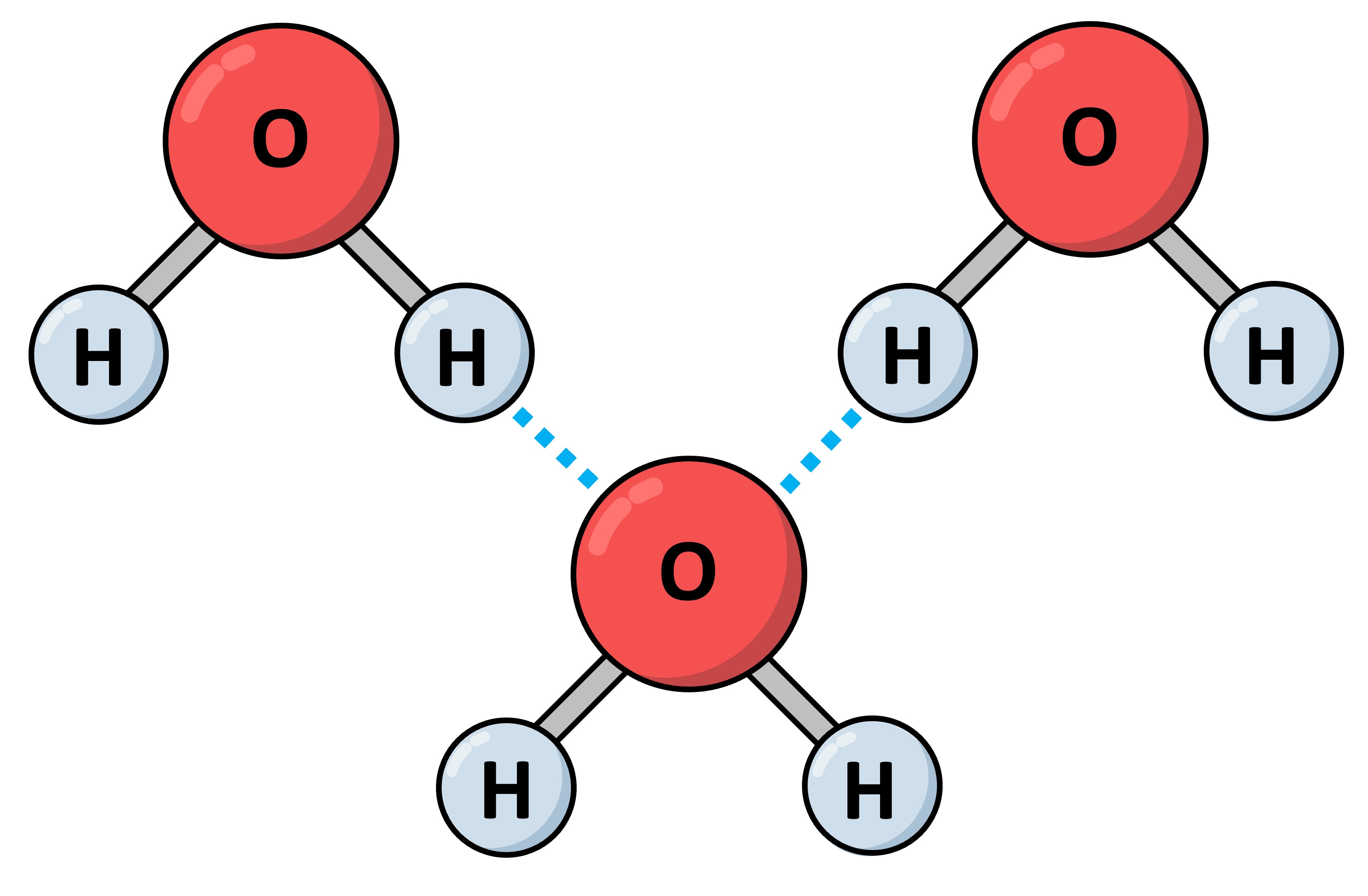
Hydrogen bonds in water molecules: the hydrogens of one molecule form fleeting interactions with the oxygens of the other (Image credit: Bioninja)
Perhaps my favorite paper of Dunitz’s is a 1997 paper titled “Organic Fluorine Hardly Ever Accepts Hydrogen Bonds”. Some explication is needed here. Hydrogen bonds are weak, fleeting bonds between hydrogen and other atoms which, while weak, are absolutely critical in keeping all kinds of molecules including proteins and nucleic acids together. In fact, water would not be a liquid without hydrogen bonds and life as we know it would not exist without them. It is their very transient nature that make hydrogen bonds “on-demand” bonds; they can be formed when needed and rapidly dissolved when no longer needed. Linus Pauling, often considered the most important chemist of the 20th century, had underscored the importance of hydrogen bonds in the 1930s in his seminal book, “The Nature of the Chemical Bond”. Typically hydrogen bonds are formed between hydrogen and what are called ‘electronegative’ atoms, ones like oxygen and nitrogen. Electronegative atoms have a particular affinity for electrons, attracting the electron clouds of atoms like hydrogen; the most common hydrogen bonds therefore are ones between oxygen and nitrogen.
There is another element on the periodic table, a most unusual one, which should be even more powerful at forming hydrogen bonds, except that it isn’t. That element is fluorine. Fluorine is in fact the most electronegative element on the periodic table, which is why we would expect it to form hydrogen bonds with furious abandon. But while inorganic fluorine found in compounds like hydrofluoric acid – a diabolically corrosive and dangerous substance – does form these hydrogen bonds, organic fluorine (fluorine bonded to carbon, that is) found in compounds like polytetrafluoroethylene – PTFE or Teflon – does not. In fact it is precisely fluorine’s reluctance to form hydrogen bonds with water in Teflon that makes it such an effective coating for non-stick cookware.
This behavior of fluorine is what the facts indicate, but the facts in this case don’t line up well with chemical theory which expects hydrogen bonding tendencies to increase with electronegativity. Fortunately there is a big database of “solved” crystal structures of organic molecules that includes molecules containing fluorine; it was only waiting for the right person to come along to interpret it. Dunitz’s paper was perhaps the first one to exhaustively analyze this database and then come up with a convincing chemical explanation for the counterintuitive observation that fluorine hardly ever forms hydrogen bonds. He looked at almost 6000 structures with fluorine and determined that hardly a dozen form hydrogen bonds between the fluorine and other hydrogen atoms. The details of why fluorine is reluctant to form hydrogen bonds is beyond the scope of this post (and explained in a further paper by Dunitz), but the qualitative explanation is simple: imagine that an electronegative element like oxygen has “hands” that pull others toward it. The problem with fluorine is that it is so electronegative that it simply keeps its hands to itself.
Even today I keep meeting chemists who, based on what seems like entirely sound chemical logic, expect fluorine to form hydrogen bonds. They recommend that one make drug molecules with fluorine that would enable them to stick better to and form hydrogen bonds with proteins that they want to block, proteins that have gone haywire in cancer, for instance. It is then that I find myself waving Dunitz’s paper – sometimes literally since I still “believe” in paper copies – with the fervent enthusiasm of a preacher.
The second paper from Dunitz that I often highlight shows Dunitz’s masterful application of simple, semi-quantitative arguments to addressing an important question. One of the most important things that scientists want to know when thinking about biological molecules like proteins is how they interact with water. All biological molecules are swimming in a vast sea of water; in fact water not just ubiquitously surrounds these molecules but is also an intimate participant in their behavior. Knowing the thermodynamics of this system – the strength of binding in particular between proteins and other molecules and water – is critical in engineering better drugs and proteins. Two factors are key in quantifying this binding: enthalpy and entropy. Roughly speaking, enthalpy concerns itself with the strength of the interactions between two molecules and entropy concerns itself with how loosely or tightly they bind, whether they stay in place or whether they jiggle around. While enthalpy is often easy to estimate, entropy is not.
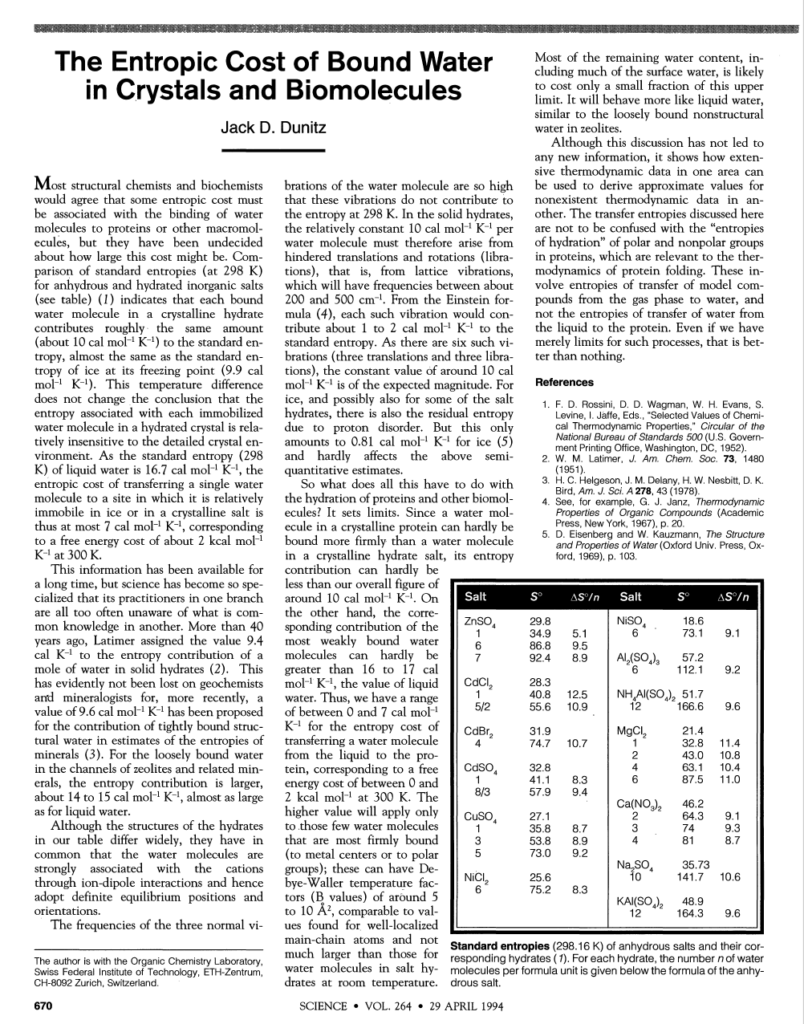
Image credit: Science
In 1994, Dunitz wrote a one-page paper in the journal ‘Science’ titled “The Entropic Cost of Bound Water Molecules in Crystals and Biomolecules” in which, using the simplest of data and arguments, he came up with a reliable number quantifying the entropy of a single water molecule binding to biological molecules. One of his strengths here which is also showcased in the fluorine paper is his ability to look at old data and come up with new explanations. He starts by looking at data on hydrates, simple salts like zinc sulfate which are surrounded by water molecules. He also looks at old data on the thermodynamics of the melting and freezing of ice which would also gives estimates on the entropy of water molecules; he points out something telling which is now a far more serious problem in our specialized world, namely that “this information has been available for a long time, but science has become so specialized that its practitioners in one branch are all too often unaware of what is common knowledge in another.”
How is thermodynamic information on ice, liquid water and hydrate salts relevant to what goes on with proteins? Because, as Dunitz astutely observes, this thermodynamics sets an upper limit on the entropy question for water around proteins: salts bind water molecules most tightly, so surely proteins would bind them more weakly? Using these arguments, Dunitz arrives at a value for the entropy of a bound water molecule which is now commonly used in calculations. The paper demonstrates characteristic Dunitzian strengths which should be widely emulated: scrupulous attention to existing data, including data going back decades, simple back-of-the-envelope calculations, and proof by analogy.
The last paper among Dunitz’s great corpus of works is a paper which exemplifies a particularly fine example of speculative as well as interdisciplinary thinking. It questioned a fact which everyone knows but no one really thinks about: Why is body temperature for animals like humans who can maintain their temperature about 36 degrees celsius, and why is it maintained across such a huge range of organisms? As we know, unless they are sick, homeothermic animals like ourselves are very efficient at regulating body heat. An explanation provided by some previous scientists pointed to the specific heat of water. Specific heat is the amount of heat required to change the temperature of a substance by one degree. Water has a very large specific heat compared to many other substances, which is just one of many of its remarkably unusual properties. But this specific heat happens to reach its lowest value at about 36 degrees celsius, just the optimum temperature mentioned above. The previous explanation said that water at this temperature was least resistant to changes in its temperature and quickly dissipated whatever heat was added to or subtracted from it.
Dunitz and his co-author, Steven Benner, found this argument “appealing, but not correct” in their response, published in the journal Nature in 1986. First, they identify what seems to be an obvious but overlooked problem: the smaller the specific heat, the easier it will be to cause fluctuations in temperature, making it harder for an organism to survive, not easier. They also realize that the previous argument only applies to pure water; water in living organisms is a complex aqueous mixture consisting of water, biomolecules like proteins and salts. So what could be responsible for the precise temperature regulation? Dunitz and Benner don’t pretend to know the answer, but they focus on two of water’s unique properties in particular, its hydrophobicity (or tendency to repel greasy, oil-like substances) and its viscosity. As temperature rises, water becomes less viscous and therefore facilitates chemical reactions in it. However, hydrophobicity also lessens with temperature, which could lead to unwanted mingling between water and greasy substances. Dunitz and Benner speculate that a temperature of 36 degrees is a Goldilocks-like zone, one where the viscosity is low enough for chemical reactions to speedily occur but hydrophobicity is high enough to prevent greasy substances from dissolving too easily.
To me this paper is a superb example of informed speculation, not pretending to solve a problem but offering a tantalizing potential solution and gently but firmly demolishing an existing explanation. It is widely believed that life anywhere in the universe would have to be based on water. Dunitz and Brenner’s analysis of the temperature dependence of water’s unique viscosity and hydrophobicity provides another window on why this substance is so unique for supporting life.
These three papers may serve to exemplify the range of Dunitz’s contributions, and they are but a slice of his vast corpus. In another analysis, he used a purely mathematical argument about the geometry of a pentagon to predict the experimentally-verified geometry of cyclopentane, a molecule with five carbon atoms arranged in a ring. His is a textbook name in many ways, none more so than in the eponymous “Bürgi-Dunitz angle” which describes the angle of attack of a reacting molecule and the precise geometric configuration of the reactants in an important class of organic reactions, one which has yielded great dividends of both academic and industrial interest.
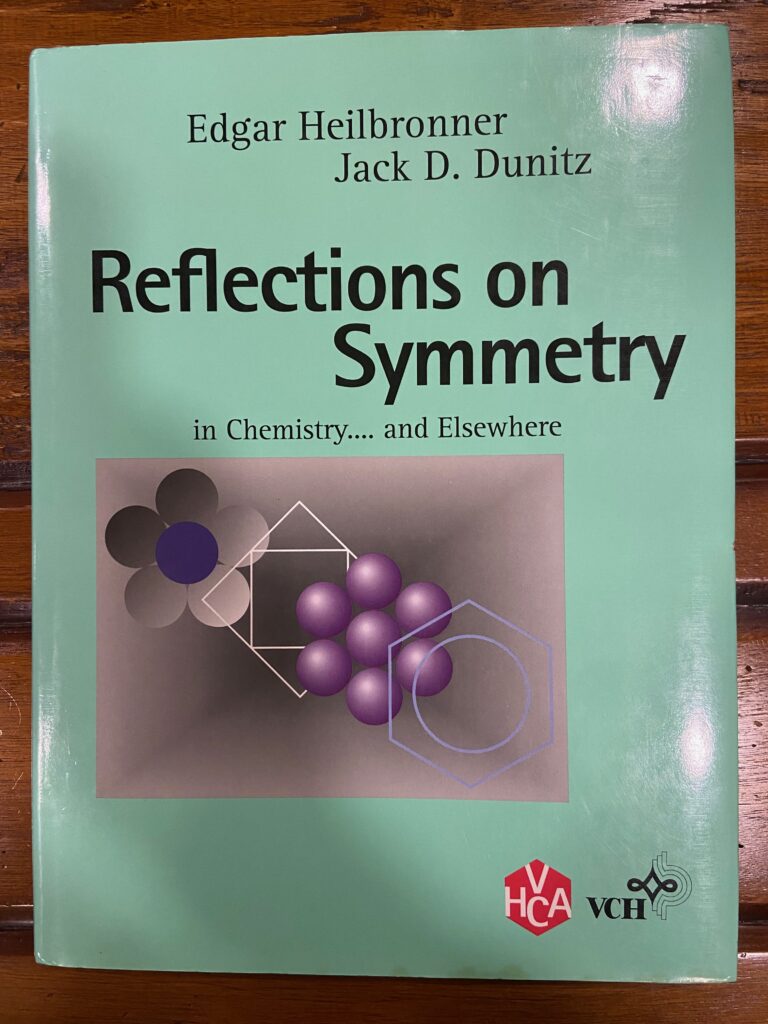
Apart from scientific papers spanning a remarkable variety of topics, Dunitz also wrote books that are considered foundational in the field. Perhaps my favorite book of his is written for laymen. “Reflections on Symmetry: In Chemistry…and Elsewhere“, written with his co-author Edgar Heilbronner, is a marvelous look at symmetry, perhaps the deepest quality of nature. Symmetry is absolutely fundamental not just for chemistry and biology but in the deepest reaches of physics, including quantum mechanics and particle physics. Dunitz and Heilbronner’s book is a romp through aspects of symmetry in fields as disparate as medieval mathematics, Islamic and modern art and of course, chemistry. It is a beautiful book, filled with illustrations and elegant arguments.
Jack Dunitz was one of those scientists who enrich everything they touch, across a wide range of domains, with insight, revelation and beauty. The simplicity and importance of his arguments, humility as a man and fearlessness in tackling disparate problems will be a candle that will keep lighting the minds of aspiring chemists and other scientists for eons to come.
In Niels Bohr's original 1913 formulation of the quantum atom, the Bohr radius r was proportional to n^2, n being the principal quantum number. Highly excited states would correspond to very large values of n and Bohr predicted these "giant" atoms would exist. Since the volume scales as r^3 or n^6, for n=33 you should see a "hydrogenic" atom a billion times larger than a ground state hydrogen atom. However, no spectral lines corresponding to such atoms were observed. So was Bohr's theory wrong?
No! Bohr pointed out that unlike physicists, *astronomers* had observed faint spectral lines in the spectra or stars and nebulae, consistent with his theory. Because of the large proportion of gas and low density, he predicted such highly excited states would exist.
Because of the extremely low densities, these excited states could live for as long as 1 second - a lifetime for an atom. In 1957, astronomers looking for electron-proton recombination in the interstellar medium serendipitously observed spectra from hydrogen atoms for n=110! In the 1970s, after Bohr's death, the advent of tunable dye lasers finally made it possible to observe these excited states in the lab. Because of their long lifetimes and huge electric dipole moments, these atoms have potential applications in quantum computing.
These "atoms" are called Rydberg atoms because Johannes Rydberg had hypothesized about these large-quantum-number states in the 19th century. But Bohr provided a physical basis and an explanation, so they should really be called Rydberg-Bohr atoms at the least. Today, Rydberg atoms have diverse applications ranging from lasers to quantum computing to plasma physics to radio receivers for military applications. But it all goes back - almost as an afterthought - to Bohr's original pioneering 1913 paper and should be recognized as such.
As someone who loved collecting vintage books, I was stoked to acquire a first American edition of Francis Galton's pioneering book “Hereditary Genius” for the bizarrely low price of $25 - most copies in good condition like this one sell for an unaffordable few hundred dollars at the minimum.
First published in 1869, “Hereditary Genius” is an important book in the history of science as well as a good example of how racist ideas are respectable in their own times. Galton was a statistician, geneticist and brilliant polymath who was one of the founders of statistics (among other ideas, he was the one who developed the concept of regression to the mean) and biometry or biological measurement. He was also Darwin’s cousin and was heavily influenced by Darwin’s ideas on survival of the fittest and natural selection.
His book was the first to make a serious and fairly exhaustive case that intelligence is inherited and genetic. He made this case almost a quarter century before Gregor Mendel figured out the nature of genes. To do this Galton made a detailed survey of what he called “eminent men” (no women, although he acknowledges this deficiency) and traced their lineage through several generations, making the case that intelligence was preserved. The eminent men included men as diverse as scientists, poets, writers, “divines”, “oarsmen” and “wrestlers from the north country”.
The book is clearly written and argued and was hugely successful both in Europe and the United States. Darwin was smitten by it and wrote:
“I have only read 50 pages of your book (to Judge), but I must exhale myself, else something will go wrong with my inside. I do not think I ever in all of my life read anything more interesting and original—and how well and clearly you put every point!"
But the book was a double edged sword. While the hereditary nature of intelligence is now accepted, Galton ended up making the case for eugenics, social Darwinism and the superiority of certain races (the examples in Galton's book are all Caucasian), arguments that were unsurprising for the times he lived in. While today his book is considered clearly incomplete and flawed, because of its novelty, clarity and reputation of its author, it became a rallying cry for eugenicists and white supremacists especially in the United States who advocated the culling of “inferior stock” to preserve intelligent races, which in their view naturally meant the Anglo-Saxon race.
An important and readable book, very much a product of its times, correct in certain fundamental ways but incorrect, incomplete and dangerous in others.
A book I have been enjoying recently is John Polkinghorne's "Belief in God in an Age of Science." Polkinghorne who died recently was a noted theoretical physicist who was also a theologian. Unlike Polkinghorne I am an atheist, but he makes a good case for why religion, science, poetry, art, literature should all be welcomed as sources for truth about the universe and about human beings. A quote I particularly like from it:
"If we are seeking to serve the God of truth then we should really welcome truth from whatever source it comes. We shouldn’t fear the truth. Some of it will be from science, obviously, but by no means all of it. It will sometimes be perplexing, how this bit of truth relates to that bit of truth; we know that within science itself often enough and we find it outside of science as well. The crucial thing is to be honest.”
I would quibble with the catch-all definition of truth in Polkinghorne's quote (scientific "truth" by its very nature is tentative) but otherwise agree. In my scientific career I have found this as well. Often Tolstoy or the Bhagavad Gita or Bach have taught me deep truths about human beings that I never saw in any physics or chemistry or mathematics textbook. The great thing about human life is its diversity. Science is the most important thing that enriches it, but it's not the only one. That's a good thing. These multiple sources of diversity should keep us busy for as long as there is a human species.
Survey of classical mechanics: Generalized coordinates and momenta. Lagrangian equations. Derivation of Hamilton’s equations from Lagrangian. Poisson brackets. Hamilton as representing invariant E under time for conservative systems.
“Pull quote”: Something simple and seemingly obvious but actually deep and foundational
Finally got around to making that "100 books I would want on a desert island" list. Another title would be "100 books that I consider essential reading for *my* life": thus, this is a personal selection. I don't claim to have this list cover the most important aspects of human life or the universe, nor do I expect "famous" books to be on this list (although some of them are). The list just reflects my personal traditional interests - history and philosophy of science has the most numbers, followed by science textbooks, general history, philosophy and theology and a tiny sliver of fiction (I started reading fiction seriously quite recently). One condition in listing these books was that I should have read them in their entirety: this is true of all of them except "Gödel, Escher, Bach" which I think I am going to keep soldiering through my whole life. I am very privileged to call some of the authors here my friends. One common thread running through most of these books is that I discovered them early, when I was in high school, college and graduate school, in most cases in either the college or university library or the British Library which was a stone's throw from where I grew up. Early impressions are often the strongest, so I keep coming back to these volumes and they keep inspiring and instructing me.
I have thousands of books on my shelf and I always find it hard to give any away. There are many others I haven't listed here which I love, but if I actually had just these 100 (110 to be precise), I wouldn't be entirely depressed (just don't tell my significant other...).
HISTORY AND PHILOSOPHY OF SCIENCE (INCLUDING BIOGRAPHY AND AUTOBIOGRAPHY)
Richard Rhodes - The Making of the Atomic Bomb Richard Rhodes - Dark Sun: The Making of the Hydrogen Bomb Freeman Dyson - Disturbing the Universe Freeman Dyson - Infinite in All Directions George Dyson - Turing’s Cathedral George Dyson - Darwin Among the Machines Edward Wilson - Naturalist Edward Wilson - Consilience James Gleick - Chaos John Horgan - The End of Science Robert Serber - Peace and War Jeremy Bernstein - Hans Bethe: Prophet of Energy Silvan Schweber - In the Shadow of the Bomb Silvan Schweber - QED and the Men Who Made It David Kaiser - Drawing Theories Apart Kip Thorne - Black Holes and Time Warps Robert Kanigel - The Man Who Knew Infinity Robert Hoffman - The Man Who Loved Only Numbers Robert Crease and Charles Mann - The Second Creation Douglas Hofstadter - Gödel, Escher, Bach Alice Kimball-Smith and Charles Weiner - Robert Oppenheimer: Letters and Recollections Peter Galison - Image and Logic Emanuel Derman - My Life as a Quant Kameshwar Wali - Chandra John Gribbin - In Search of Schrödinger’s Cat John Casti - Paradigms Lost John Casti - The Cambridge Quintet John Casti - Gödel: A Life in Logic George Johnson - Strange Beauty Roger Penrose - The Emperor’s New Mind Roger Penrose - The Road to Reality Richard Dawkins - Climbing Mount Improbable Gerald Durrell - My Family and Other Animals Konrad Lorenz - King Solomon’s Ring Robert Laughlin - A Different Universe Horace Freeland Judson - The Eighth Day of Creation Peter Michelmore - The Swift Years: The Robert Oppenheimer Story Richard Feynman - Surely You’re Joking Mr. Feynman Stanislaw Ulam - Adventures of a Mathematician Laura Fermi - Atoms in the Family Werner Heisenberg - Physics and Philosophy Ronald Clark - Einstein Steven Pinker - The Blank Slate David Deutsch - The Beginning of Infinity Steven Weinberg - Dreams of a Final Theory J. Robert Oppenheimer - The Open Mind Stuart Kauffman - Reinventing the Sacred Barry Werth - The Billion Dollar Molecule Oliver Sacks - On the Move Carl Sagan - The Demon-Haunted World Max Perutz - I Wish I’d Made You Angry Earlier Jonathan Allday - Quarks, Leptons and the Big Bang Philip Ball - H2O: A Biography of Water Philip Ball - The Self-Made Tapestry Alan Lightman - Einstein’s Dreams Alan Lightman - The Accidental Universe Brown, Pais and Pippard - Twentieth Century Physics (3 volumes) Ed Regis - Who Got Einstein’s Office? C. P. Snow - The Physicists
TEXTBOOKS
Ira Levine - Quantum Chemistry Peter Atkins - Molecular Quantum Mechanics Lubert Stryer - Biochemistry Albert Lehninger - Biochemistry George Simmons - Introduction to Topology and Modern Analysis George Simmons - Differential Equations Richard Feynman - The Feynman Lectures on Physics David Griffiths - Introduction to Electrodynamics John Lee - Inorganic Chemistry Samuel Glasstone - Sourcebook on Atomic Energy Samuel Glasstone - Thermodynamics for Chemists Arthur Beiser - Concepts of Modern Physics Gautam Desiraju - The Weak Hydrogen Bond Linus Pauling - The Nature of the Chemical Bond Linus Pauling and Edward Bright Wilson - Introduction to Quantum Mechanics Clayden, Warren, Reeves and Wothers - Organic Chemistry Eric Anslyn and Dennis Dougherty - Modern Physical Organic Chemistry Wells, Wells and Huxley - The Science of Life Goodman and Gilman - The Pharmacological Basis of Therapeutics Jerry March - Advanced Organic Chemistry
HISTORY
Barbara Tuchman - The Guns of August William Shirer - The Rise and Fall of the Third Reich James Swanson - Manhunt: The 12-Day Chase for Lincoln’s Killer David McCullough - Truman James Scott - Against the Grain James McPherson - Battle Cry of Freedom Gordon Wood - Empire of Liberty John Barry - Roger Williams and the Creation of the American Soul Bernard Bailyn - The Ideological Origins of the American Revolution Robert Caro - The Years of Lyndon Johnson (Vols. 1-4) Rick Atkinson - An Army at Dawn Will Durant - Our Oriental Heritage Russell Shorto - The Island at the Center of the World Nick Bunker - An Empire on the Edge Brad Gregory - Rebel in the Ranks Cornelius Ryan - The Longest Day
PHILOSOPHY AND THEOLOGY
Sam Harris - The End of Faith David Edmonds and John Eidinow - Wittgenstein's Poker Plato - The Republic Matthew Stewart - The Courtier and the Heretic Isaiah Berlin - The Proper Study of Mankind Bertrand Russell - Unpopular Essays Bertrand Russell - Why I am Not a Christian
FICTION
Vasily Grossman - Life and Fate Haruki Murakami - What I Talk About When I Talk About Running Cormac McCarthy - Blood Meridian Cormac McCarthy - The Road Isaac Asimov - Asimov’s Mysteries Cordwainer Smith - No, No, Not Rogov! (this is a single story but it is very striking in its vividness and poetry and made a deep impression) Leo Tolstoy - War and Peace Fyodor Dostoevsky - Notes from the Underground William Faulkner - As I Lay Dying H. G. Wells - The Time Machine Chekhov - Stories
Erwin Schrödinger's book, "What is Life"?, inspired many scientists like Crick, Watson and Perutz to go into molecular biology. While many of the details in the book were wrong, the book's central message that the time was ripe for a concerted attack on the structure of the genes based on physical principles strongly resonated.
However, influence and importance are two things, and unfortunately the two aren't always correlated. As Sydney Brenner recounts in detail here, the founding script for molecular biology should really have been John von Neumann's 1948 talk at Caltech as part of the Hixon Symposium, titled "The General and Logical Theory of Automata". In retrospect this talk was seminal and far-reaching. Brenner is one of the very few scientists who seems to have appreciated that von Neumann's influence on biology was greater than Schrödinger's and that von Neumann was right and Schrödinger wrong. Part of the reason was that while many biologists like Crick and Watson had read Schrödinger's "What is Life?", almost nobody had read von Neumann's "General and Logical Theory of Automata".
As Brenner puts it, Schrödinger postulated that the machinery for replication (chromosomes) also included the means of reproducing it. Von Neumann realized that the machinery did not include the means themselves but only the *instructions* for those means.
That's a big difference; the instructions are genes, the means are proteins. In fact as Freeman Dyson says in his "Origins of Life", von Neumann was the first to clearly realize the distinction between software (genes) and hardware (proteins). Why? Because as a mathematician and a generalist (and pioneer of computer science), he had a vantage point that was unavailable to specialist biologists and chemists in the field.
Unfortunately abstract generalists are often not recognized as the true originators of an idea. It's worth noting that in his lecture, von Neumann laid out an entire general program for what we now call translation, five years before Watson, Crick, Franklin and others even solved the structure of DNA. The wages of the theoretician are sparse, especially those of the one, as mathematician John Casti put it, who solves "only" the general case.